Tuesday, 8 May 2012

Vango Force Ten Helium 100 Tent Review

I have had this tent Vango Force Ten Helium 100 2012 Version since its release in early March and have enjoyed several overnight wild camps with it in the Pennines and Lake District.

Weight wise it is certainly not the lightest 3 season tent on the market, but it still comes in at a very respectable 1.19kg which to be fair is not a great deal heavier than the bivi bag I often use.

First impressions of the tent when it arrived were pretty good, as was the quality of the material and its construction. I won't go in to detail about the materials, as this info is readily available from the manufacturer using the above link.

The tent pitches outer first but I simply leave the inner and outer together and pitch it as one. Pitching is quick and easy and it is simply a case of sliding the alloy pre-bend poles into the flat seam of the fly and then adding the short poles to the ends as you peg out - very simple and very quick.

In practice the tent performs well but there are a few niggles worth a mention and yet again we have a mountain tent manufacturer that has skimped on an important element of the tent - the pegs. Frustratingly the short alloy 10cm pegs like many of those supplied by lightweight tent manufacturers are not really up to the job. To be honest they are certainly no worse than their competitors pegs. For example the toothpicks supplied with the Terra Nova Competition, but it really does annoy me that tents such as these are supplied with rubbish pegs. Yes manufacturers such as Vango and Terra Nova for example clearly state that the supplied pegs are for solid ground, but lets face it these tents are portrayed as hill tents and from my own experience it is pretty rare to find the sort of ground these short pegs work well in. It seems to me that in order to satisfy the gram counters, some lightweight tent manufacturers supply pegs that are barely adequate for real life use, preferring instead to supply pegs that are more suited to low level grassy campsites. Like a lot of people I tried them and then swapped them for longer pegs. (from one of my old vango tents) before venturing into the mountains. With this in mind if you are considering buying a lightweight tent from this and to be fair some other manufacturers, it is worth taking into consideration the added weight, hassle and expense of having to obtain pegs that are fit for purpose.

04D-4479 Walker Wild Camping in a Woodland Using the Vango Force Ten Helium 100 Tent UK
Low level woodland camp

The living space is quite roomy and at 5'9" I can sit up with my head just touching the inner. Lengthwise there is plenty of space to lie down with plenty of room at the head and foot ends for my rucksack and other kit such as boots, spare clothes or whatever. The porch area is a little on the small side though. At around 35-40cm or so at the widest point it is fine for leaving muddy boots, water and general cooking paraphernalia in, but it is certainly not big enough to store my 35ltr backpack or to cook in safely. There is a simple work around as the inner itself is quite roomy and all you have to do is unclip the inner floor and roll it back. This then creates adequate space for cooking in foul weather and leaves just enough space for the rucksack if it is wet - otherwise I keep the empty rucksack inside and use it as a pillow.

As far as coping with the weather the tent has performed well even in relatively strong winds (strong enough to blow me around while walking) and pitched side on to the wind with an additional guy line to the windward direction it coped pretty well. Like all tents of the single hoop design it was difficult to get a super taught pitch and flapping fabric did make things fairly noisy. That said this issue is pretty much the norm for most tents with a single hoop design and I was well aware of this before purchase.

04D-7844 Lightweight Backpacking Tent on the Lower Slopes of Dale Head with the Mountain of High Spy Behind Lake District Cumbria UK
A relatively sheltered pitch near Dale Head Tarn with the mountain of High Spy behind. Lake District Cumbria UK.

One area I still have slight reservations about is the inner, which seems to be very loose even when the outer is well tensioned. One issue I did note was that during strong winds as the poles flexed and sprung back, the inner would also flap around and then touch the fly. This meant that even when it was not raining any condensation that has built up on the fly is transferred to the inner and then as a fine spray on me. It has to be said at this point that condensation is not a major issue and all tents experience a little depending on the conditions. To overcome this I shortened the elasticated inner guys to ensure the tension of the inner was greater. On subsequent trips while an improvement and no condensation got to me, I still noticed the fabric was a little saggy. With this in mind I may tighten the elasticated loops at the top a little more.

To help add greater stability in windy conditions the patented Tension Band System(TBS) seems to work very well and adds to the overall stability significantly. It can be a bit of a fiddle as it runs through the living space and inner door and can get in the way at times, however the advantages of the system in strong winds overrides this very minor point. When not required it can be unclipped and coiled out of the way. When in use it does make a handy airing line for socks though.

Verdict - All in all I am pretty happy with this tent so far but the jury is still out as far as the inner tension goes and it will take a few more trips before I can say for sure that it will not affect performance during very wet weather.

Pros
· At £170.00 (RRP £220.00) it is certainly an affordable tent and will I am sure hold its own against many of the other more expensive makes of tent.

· The angled poles and the very snug pole sleeve do appear to provide a stable pitch in strongish winds (tested in 25-30mph approx with the odd gust much higher)

· The TBS works well and does help stabilise the tent when it is windy.

· At 1.19kg it will be lightweight enough for most solo outdoor users.

· Has a decent interior living space,

· Has adequate ventilation


Cons (based upon personal preferences as opposed to major design flaws)
· Porch could be bigger to enable a rucksack to be stored in it or for cooking in bad weather.

· The inner is a little too baggy and can flap against the fly in gusty winds.

· The pegs like most other lightweight tents are not really up to the job on the hill.

· The TBS can get in the way and is a bit of a fiddle to remove out of the way when not needed. That said it is handy for hanging stuff on during the night

· Can be noisy in strong winds but then so are most single hoop tents of this design.

· The inner lacks a pocket to place things such as glasses, torch etc.


Finally - it is time for us to replace our two person mountain tent which is an aging Terra Nova Explorer four season mountain tent. We will be going to the Pyrenees over the summer and if anyone has any experience or info that will help us make an informed decision on its replacement it would be great to hear from you.

Tuesday, 1 May 2012

Video - North Pennines AONB

This is our latest video produced in association with www.greentraveller.com and the North Pennines AONB Partnership www.northpennines.org


Monday, 23 April 2012

Swallows

I saw the first Swallow (Hirundo rustica) of the year at the weekend. It is the only one at the moment and sits on the line outside the house chattering away to itself. Where its pals are I don't know, but looking back at my records it is quite common for one to turn up a week or so ahead of the rest. Perhaps this behaviour gives rise to the saying "a single Swallow does not a summer make". One thing for certain summer is going to be a while yet and it must be feeling the cold as the showers of sleet, hail and heavy rain sweep across from the Pennines. It is great to see them back and hopefully they will provide a few photo opportunities like the ones below over the summer.


02D-8737 Adult Swallow Hirundo rustica Feeding its Young at the Nest United Kingdom
Copyright David Forster


I usually avoid photographing birds at the nest for obvious reasons, but this pair were so habituated to humans that disturbance was not an issue. They had set up home in a low roofed passageway leading to a friends house and were quite happy to have people walking within a couple of feet of the nest. In fact the first time I encountered them I met one in the actual passageway and instead of flying away it hovered in front of me until I stepped aside and it could fly past. Before I had reached the end of the passage I heard a "chirrup chirrup" behind me and then felt the sweep of its wings as it flew past my ear on its way back out to collect more food. I know you should not give wild animals human qualities but it really did feel as if it was warning me it was coming past.

02D-8623a Adult Swallow Hirundo rustica Feeding its Young at the Nest United Kingdom
Copyright David Forster


Manmade structures such as barns make excellent nest sites and coupled with the abundance of insects that can be found in the surrounding fields these birds can usually manage to bring up more than one brood over the summer. The nest itself is made from mud collected from puddles and streams and is reinforced with grass and straw and then lined with feathers.

07-9886 Swallow Hirundo rustica Collecting Mud
Collecting mud from a puddle on the nearby farm track. Copyright David Forster


In May/June they lay a clutch of five or six eggs and once these have hatched out and fledged they will often produce a second smaller clutch of two to four eggs which will usually have hatched and fledged by the end of September. The whole family then heads off to make the long migration back to their wintering grounds in Africa. You really have to admire the Swallow.

Monday, 2 April 2012

Lake District - Fleetwith Pike Wild Camp

As a mountain Fleetwith Pike is not quite what it seems. In many ways it is a real mountain of contrasts. When viewed from Honister pass, or from a walk upon its southern or eastern slopes, it is a mountain ravaged by the heavy industry of mining and quarrying. Yet despite the ravages of industry it is also a mountain of beauty and provides some wonderfully panoramic views of its neighbours - Kirk Fell, Great Gable, Haystacks and Pillar. All of which can be taken in with a single sweep of the eye. On the northern side where cliffs plunge down hundreds of feet to the grey screes above the Honister pass road the views are limited by its loftier neighbour Dale Head. You do however get some good views of the old mines and inclines at Yew Crag, all of which are slowly being reclaimed by nature.

Beyond the wonderful panoramas, the greatest contrast comes from within the mountain itself. Here in the darkness in the heart of the mountain men and machine still toil by tearing down great slabs of grey-green slate and then hauling them out into the daylight to be processed into roofing slate, walling stone, and much more. A number of years ago when the mine was closed and few people thought it would ever reopen I was fortunate to spend some time exploring and photographing the workings. I have added a couple rather poor scans from some pretty ropey old negatives just to give you an idea of how the workings looked in those days.


Honister Incline
Incline where the slate was lowered through the mine. © David Forster


Honister Mine Main Chamber

The large Cathedral like chamber in the main workings. There are three cavers in the chamber can you spot them all? © David Forster


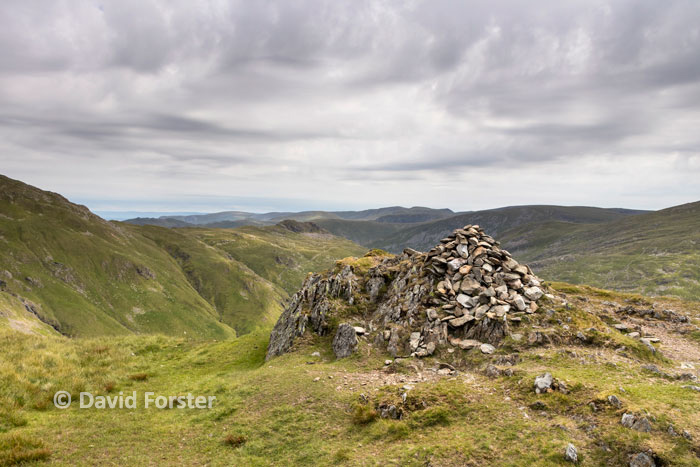
For me though it is the summit at the western end where the ground falls steeply away that gives the best viewpoint. From the cairn the view west down the length of the Buttermere valley and to the coast beyond is wonderful. It was here hidden among the folds of rock and grassy ledges we planned to have a quiet wild camp, watch the sunset, enjoy the sunrise and generally chill out - and of course capture a few images.

It took us a little longer to reach the summit than we had planned because every now and again we were forced to stop, not I might add to rest tired legs, but to simply admire the view and soak up the atmosphere. Eventually in the un-seasonal heat and accompanied by the sound of Skylarks we reached the summit. We were not alone in seeking this lofty viewpoint and there was already a family enjoying a break in the evening sunshine. After spending a while taking in the view and exploring the summit area a little we searched for a quiet secluded spot to put up the tent and get a brew on. Later as the sun began to set we poured ourselves a cup of coffee and as the stove ticked itself cool we listened to the breeze whispering across the hillside, creeping through the rocks and then with a final sigh, slipping gently over the summit to the valley below. With the world beyond completely forgotten it was a moment of true freedom and relaxation. Unfortunately and despite our earlier optimism the sunset never did produce the colour and atmosphere I had anticipated, so instead of photography we simply sat and immersed ourselves in the view. Photography wise all was not lost though and once the sun had dropped below the hills, a damp mist began to creep in from the coast giving the valley a monochromatic almost Tolkeinesque atmosphere. Finally, unexpectedly, the images came.


04D-4965a Hill Walker and the Buttermere Valley in Misty Late Evening Light From the Summit of Fleetwith Pike Lake District Cumbria UK.
The view west along the Buttermere Valley towards the coast. © David Forster


Later as darkness descended so did the cold and we donned an extra layer, determined to make the most of the night before retiring to the tent. As we watched the darkness creep up the mountainsides and as Jupiter and Venus appeared above, we noticed the lights of someone making their way off the fell. As always when I see such lights in the mountains I hoped they had planned their night time adventure, rather than having it forced upon them at the end of a trying day. The lights appeared and disappeared intermittently as they slowly progressed down the mountain and as the cold drove us into our sleeping bags I silently wished them a safe passage.


Tent
Jupiter Venus and the Moon tracking across the night sky. © David Forster


In the morning the sun was unable to penetrate the mist and low cloud to the east and we were denied a colourful sunrise. Even so as we took down the tent and watched the flattened grass slowly spring back over a cup of coffee, it was impossible to feel any sense of disappointed in such wonderful surroundings.


04D-5187 Tent on Fleetwith Pike and the View Towards the Mountain of Pillar in Early Morning Light Lake District Cumbria UK
Pillar Mountain from the tent. © David Forster


When the sun eventually broke through it was too high to colour the clouds, but still provided some wonderful light to chase away the morning chill. While Moira got the stove going for another drink and then sat on a rock reading in the sun, I wandered the short distance to the summit for some more photography. Below to the west Buttermere appeared mirror calm, the blue of the sky reflected deeply in its chill waters.


04D-5174 Woman on Fleetwith Pike Reading a Book in Early Morning Light with the View South Towards the Mountains of Great Gable and Kirk Fell Lake District Cumbria UK.
Moira reading. © David Forster


04D-5198 The Buttermere Valley From the Summit of Fleetwith Pike in Early Morning Light Lake District Cumbria UK
Buttermere in morning light. © David Forster


04D-5001 The Summit of Fleetwith Pike and the View South Towards the Mountains Of Great Gable and Kirk Fell in Misty Late Evening Light Lake District Cumbria UK
The summit with the view towards Great Gable and Kirk Fell © David Forster


So often when we stand on a mountain summit we are accompanied by the roar of the wind, but this morning it was completely calm. In fact so calm I could hear the purr of our stove 20 meters away. An hour later with photography completed we simply stood there gazing, absorbing the feel of the landscape and listening to the sounds of the mountains, before finally and reluctantly, turning around and making our way back to the pass.

All text/images copyright David Forster


Below is a Short Video of the Trip


Tuesday, 27 March 2012

Photographing Adder Again

Adders to me are beautiful creatures, especially so when you get up close and observe the colour and detail of their scales. They are well adapted to the moorland environment and blend in among the heather and bracken completely. So much so that even close up their scales take on the shape and texture of leaves. It is almost as if they were formed from the very earth itself. Even on the lighter males the black zigzag pattern along their back from some angles appears as a sun cast shadow from a bracken frond.

These are a few images from the day.


04D-4594 Adder Vipera Berus Teesdale County Durham UK.

Adder Vipera berus. © David Forster


04D-4719 Adder Vipera Berus Teesdale County Durham

Even the black markings on their backs appear as shadows cast by the bracken. © David Forster


04D-4702 Adder Vipera Berus

Close up of the head of a male Adder (Vipera Berus). © David Forster


07-9157 Adder Vipera berus

An image from a previous visit which shows how their markings help them blend into their environment, even in the open. © David Forster

Saturday, 10 March 2012

Video - A Winter Walk in Upper Teesdale

This is a video short of a larger project I am working on which is supported in part by the North Pennines AONB Partnership about trekking in the North Pennines Area of Outstanding Natural Beauty (AONB). If you are looking for a landscape in England that has more than just the essence of wilderness about it, then the North Pennines and Upper Teesdale in particular will certainly go a long way in meeting your needs. Such is the geological and climatic diversity of this part of the Pennines the area has actually been scientifically classified as a sub arctic region and is recognised as a European and Global Geopark. Without a doubt to walk here is to step back in time, this really does feel like England's last wilderness.


Wednesday, 7 March 2012

A Frogs Eye View

As I wandered over the moors with the warm sun on my face accompanied by the forlorn calls of Golden Plover it certainly felt as if spring was just around the corner. My main goal today was to see if I could get a few more images of the adders I have been photographing over the last few years. Unfortunately I was spotted before I got close enough and only managed a few record shots before the only one basking silently disappeared back underground. Still a sighting is better than nothing.

04D-3824a Adder Vipera Berus

Only a record shot today of the Adder (Vipera Berus) but it is nice to see it has survived the winter


Moving on I heard the chorus of croaking frogs well before I saw them. Again I was spotted and the closer I got the quieter they became until all I could hear were the plops of each one as they hopped into the water. There is one thing you need to have if you like photographing wildlife and that is patience. I knew they would resurface if I stayed still and ten minutes later a few smug looking individuals began to push up through the thick soup of weed and jelly-like frogspawn - the pupil black centres of which stared back at me like some watery eyed creature.


04D-4119 Frogspawn of the Common Frog Rana temporaria in a Pond UK

Frogspawn - © David Forster


Resisting the temptation to start shooting straight away I waited a little longer allowing them to get used to my presence as I inched slowly forward. Soon we were all eye-to-eye only inches away from each other. At this level with my nose almost touching the water I could see the world from a frogs eye view. Coated in a viscous layer and with coal back pupils set in aged gold leaf they stared unblinkingly back at me with an air of contented smugness. Such happy contentment is hardly surprising, especially when you look at the fun they were having as they wriggled and writhed together among their spawn.


04D-4012 Common Frogs Rana temporaria Surrounded by Frogspawn UK.

© David Forster


04D-3940 Common Frogs Rana temporaria Surrounded by Frogspawn UK

Despite disappearing when they saw me they soon reappeared - © David Forster


04D-3921 Through the eyes of a frog.

My reflection - © David Forster


Spring is definitely well on the way even on the high moors of Teesdale and judging by the activities of this little group there will be tadpoles aplenty in the coming months.


What is the difference between a Frog and a Toad?

Common Frog (Rana Temporaria)
· Green/brown in appearance with a smooth skin.
· Jumps rather than walks
· Mostly lives in an aquatic environment
· Lays eggs as a ball of Frogspawn


09-0871  Common Frog Rana Temporaria Teesdale County Durham

Common Frog (Rana Temporaria) - © David Forster


Common Toad (Bufo bufo)
· Brown in appearance with a warty skin
· Walks rather than jumps
· Does not live in an aquatic environment.
· Lays its eggs in a string rather than a ball.


09-2550 Common Toads Bufo Bufo Mating

Male and Female Common Toads (Bufo bufo) in Amplexus - © David Forster